


The stitching of inflatable balls is confined to household units, where children below the age of 14 were engaged in stitching of inflatable balls along with the elder members of the family. In 1995 the first reports appeared in newspapers about the large-scale use of child labour and exploitation of adults in the football industry of Sialkot, Pakistan. A couple of years later it became clear that the same problem also existed in India.
|
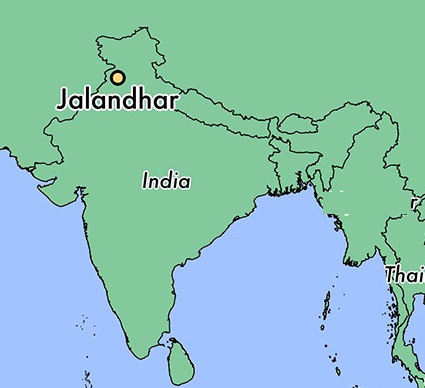
The employment of children in the sports goods industry in India came to the fore after the US Department of Labour in its document 'By the Sweat and Toil of Children' highlighted the problems of children working in this industry. As a sequel to this, a UK based NGO 'Christian Aid Society', in collaboration with South Asian Coalition on Child Servitude (SACCS) made the first attempt to highlight the situation of working children in the sporting goods industry in the cities of Jalandhar and Meerut in 1997. The result of the survey, which estimated that 25,000 - 30,000 children were working in the sports goods industry, evoked strong objections from the manufacturers. This report however did prompt an independent research study funded by ILO-IPEC and FICCI in 1998. The research carried out by V. V. Giri National Labour Institute (NLI) concluded that around 10,000 children were stitching footballs in the district of Jalandhar (other producing areas were not included). Nearly 1350 of these were reported to be working full time in the home based production of sports goods. |
` |
This impacted the Jalandhar sports goods cluster tremendously as foreign brands started pulling out of the cluster to save their brand image, which included Nike, Adidas, Reebok, Mitre (UK) and others. The manufacturers of the Jalandhar cluster were highly impacted as …85.. per cent of the cluster product is exported.
Prior Initiative
The child labour issue of the Jalandhar sports goods cluster was not only a national issue but an international issue as various international organizations were involved with the cluster. SACCS along with the sports goods exporters tried to take various steps to address the child labour issue in the cluster. SACCS started its Fair Play Campaign and setting up schools for former child stitchers, a mother’s training centre and an awareness raising programme in Jalandhar and Meerut. To address this social issue that impacted the Jalandhar cluster economically, the exporters initiated the Sports Goods Foundation of India (SGFI) and started working towards an agreement with organizations like the World Federation of Sporting Goods Industry (WFSGI), ILO-IPEC and Save the Children. This approach was based on the so-called 'Atlanta Agreement' (signed in February 1997), which formed the basis for a programme to eliminate child labour from the football industry in Sialkot, Pakistan. However, the 'Atlanta Agreement for India' which was supposed to be signed in February 1999, never materialized. The Government of India (GOI) took the decision not to allow ILO-IPEC to supervise the external monitoring as it was felt that too much money would go to management of the programme and too little would be available for the children concerned.
The Solution: Click here for Documentary
The SGFI, a joint effort of 25 exporters of sports goods, went ahead with a programme to prevent and rehabilitate child labour in the cluster, after the expulsion of ILO- IPEC. SGFI is registered under Societies Registration Act XXI of 1860 vide Registration No. 1681 of 1998-99 Dated 25th January 1999 as an NGO. It is a non-profit making organization committed to the prevention and rehabilitation of child labour in the sporting goods industry. Currently the membership has increased to 26 exporters. The objective of the organization were-
- To prevent and progressively eliminate child labour in the manufacture or stitching of Soccer balls.
- To facilitate an attitudinal change in the community as well as the worker’s families regarding the importance of education and evils of child labour.
- To promote education in the inflatable balls stitching community.
SGFI, under the guidance of the WFSGI, ISL and major sports goods companies, hired the well-known auditing company SGS (Societé General de Surveillance) to do the external monitoring of the stitching locations. The list of these locations was provided by the manufacturers on the basis of their internal monitoring. The external monitoring was funded by FIFA, while the manufacturers contribute a percentage of their export earnings for the rehabilitation of the children.
The various technical and donor organizations that partnered with SGFI were.
WFSGI: The World Federation of Sporting Goods Industries, Switzerland has been involved with the Foundation to address the child labour since its inception. They have been working hard to coordinate efforts of the major international brands and the manufacturers.
SGS India Pvt. Ltd: The auditing company SGS (Societe General de Surveillance) was hired to take up the external monitoring of the stitching locations. The company had set up an office in Jalandhar and is also the certifying body for ISO 9001:2000 of the cluster and auditing the monitoring program regularly.
FIFA Marketing: had funded the monitoring program by SGS for four years Jan-2000 to Dec-2003. FIFA Marketing has allowed its licensees to produce these balls in India only from firms that are members of the Foundation and who are all in compliance with the rules of the foundation.
UNICEF: It brought enormous wealth of knowledge on issues related to the exploitation of children, social awareness for the Foundation.
SCF-U.K: Save the Children’s Fund-U.K, was involved in this program even before the Foundation was officially started. Their active participation in the program along with UNICEF has been the key factor in getting the social protection program started. They suggested that a steering committee be formed between the Foundation and its partners so that the monitoring and social protection program can constantly be reviewed.
Govt. of India, Dept. of Labour: have been supporting the Foundation and its objectives from the beginning. There were a key role in the establishment of the 27 Transitional Schools in Jalandhar, 8 of which were being run by the Foundation. They provide a substantial grant for the running of these schools and in shaping the social protection program.
United Nations Industrial Development Organization- Cluster Development Project (UNIDO-CDP): SGFI has been sub-contracted a three year project on Corporate Social Responsibility by United Nations Industrial Development Organization- Cluster Development Project (UNIDO-CDP). This project is called Social and Environmental Responsibility of Businesses (SERB). Under this project SGFI has scaled up its child labour project with more community participation and home-based workers, strengthened educational initiatives, focus on health and safety at workplace and Environment issues. SGFI is also providing advice to its members on Social Compliance to handle social audits done by their respective customers.
Lions Club – Jalandhar East: Lions Club has partnered with SGFI for health awareness camps. The team of doctors is from Lions Clubs. SGFI has also created 5 tuition centers that have been adopted by 5 different lions clubs.
Life Insurance Corporation of India (LIC): SGFI has partnered with LIC to promote micro insurance scheme ‘Jeevan Madhur’ & ‘Bhagyalakshmi’ amongst its household workers. Till date it has covered 3000 workers.
The Impact.
- The various international clients that import sports goods from the cluster are …Walmart, Coca Cola, Reebok, Nike, Adidas, Gilbert, Mitre, Spalding, etc….
- Till date around …1350…. children those who were working in the cluster are going to schools.
- Under NCLP, SGFI had adopted 8 schools that provide education to around 400 children from the stitcher community.
- The Muskaan centre is helping around …900… children to cope up with their day to day studies.
- Through health camps around 152 eye surgeries have been performed in the last two years, 2 bone density and diabetes check up camps, 2 drug awareness camps and various dental camps have been organized with the support of Lions club.
- Under the insurance scheme ‘Jeevan Madhur’, 2000 workers have been insured.
- To check the incidence of child labour, around 3300 families are monitored covering over 15000 stitchers, so that child labour can be eliminated.
- The various awareness campaigns of the SGFI have been very successful in reaching the stitchers that brought a dramatic change in the attitude of the community against child labour. The community now understands the significance of children going to school and enjoying their childhood instead of working.
The Conclusion.
This case study is a unique illustration of the linkage between competitive advantage and social responsibility. The responsible act of the Jalandhar Sports Goods cluster not only helped the stakeholders in retaining their international client but also attain a esteemed position in the mind of the people. Seeing the working of SGFI, the CBSE (Central Board of Secondary Education), New Delhi has included a chapter titled “SGFI & its Organizational Setup” in the official text book of health, physical education and sports for class XII nationwide. IIM (Indian Institute of Management) Bangalore has written a 28 page case study on SGFI which will be taught to MBA students this session onwards. The same is being taught across 500 B-schools worldwide.
 +91-181-2685173 | +91-9216020377
 sgfi@sgfi.org